How they tested it
Tests with known ground truth — with a realism trade-off
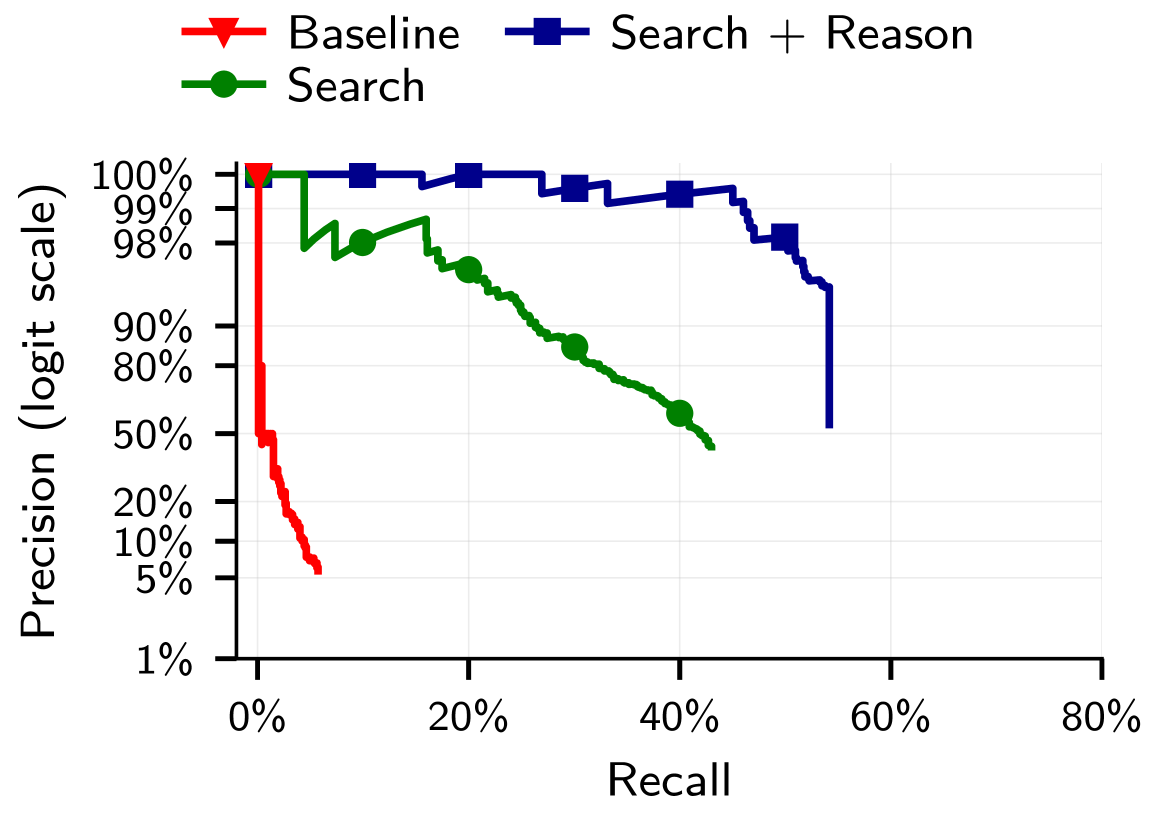
Paper Fig. 3a: the HN ↔ LinkedIn precision–recall curve. Baseline (red) collapses; Search (green) helps; Search + Reason (blue) holds near-100% precision far longer.
Three settings, known answers
Hacker News ↔ LinkedIn: profiles that publicly link both accounts, matched across platforms.
Reddit movie communities: 9,781 users matched across r/movies and five specialist communities.
Reddit split in time: one user’s history split into “earlier” and “later” halves, treated as two pseudonymous profiles.
Trade-off: they removed obvious identifiers before testing, then checked whether the system recovered the correct link. Safe and measurable — but these users may share more identifying information than a genuinely privacy-conscious person.
Paper §3.1–3.3 and §5. Ground truth comes from self-linked accounts or from splitting one user’s activity.
Results
What the full pipeline achieves
68%
recall at 90% precision — the best LLM-pipeline result across all settings. Many true matches, most guesses correct.
0.1% → 45.1%
recall at 99% precision on HN ↔ LinkedIn — after the full LLM pipeline, vs 0.1% for the classical baseline.
8.5%
recall at 90% precision on Reddit movie communities — thin content, much harder than professional profiles.
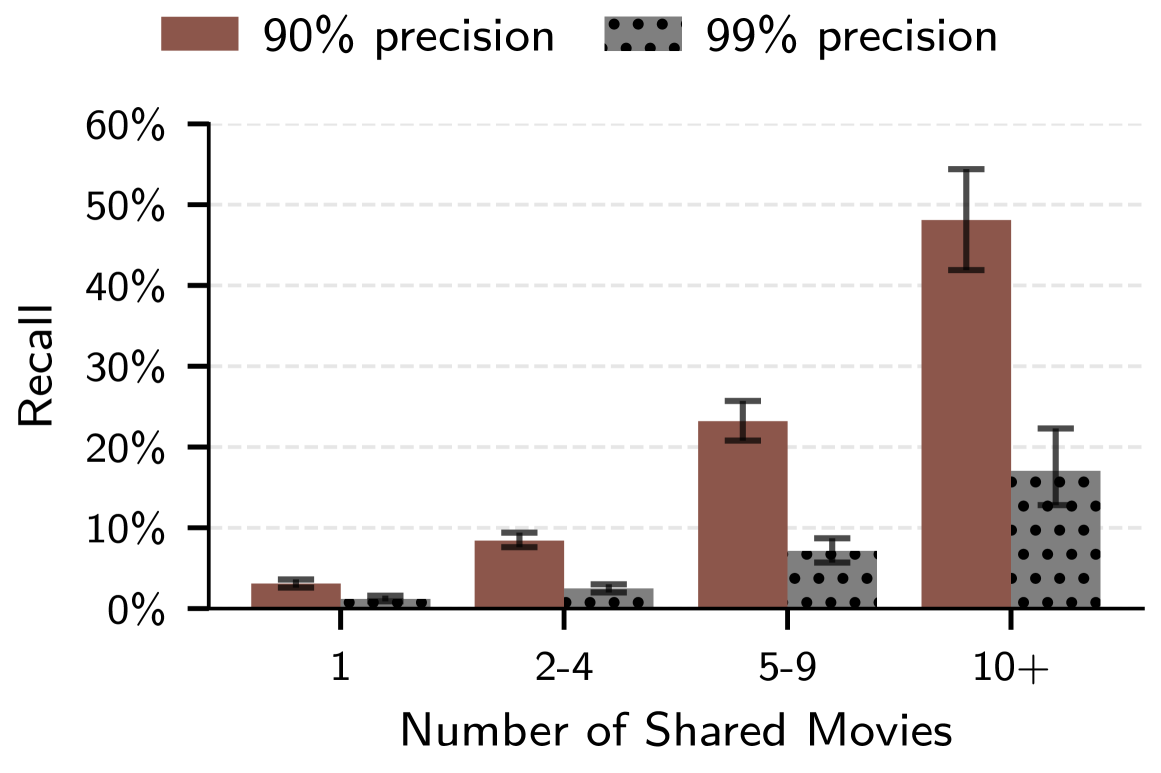
Paper Fig. 4b: recall rises sharply with shared content — 3.1% at one shared movie → 48.1% at 10+.
What the curve says: the more a user’s two accounts overlap — movies, interests, activity — the more linkable they become. Even mundane preferences accumulate into a fingerprint. Precision and recall are reported together because a wrong identification is not a benign failure.
Paper abstract, §2.1, Table 1, Fig. 4b. Recall is always reported at a fixed, very high precision target.